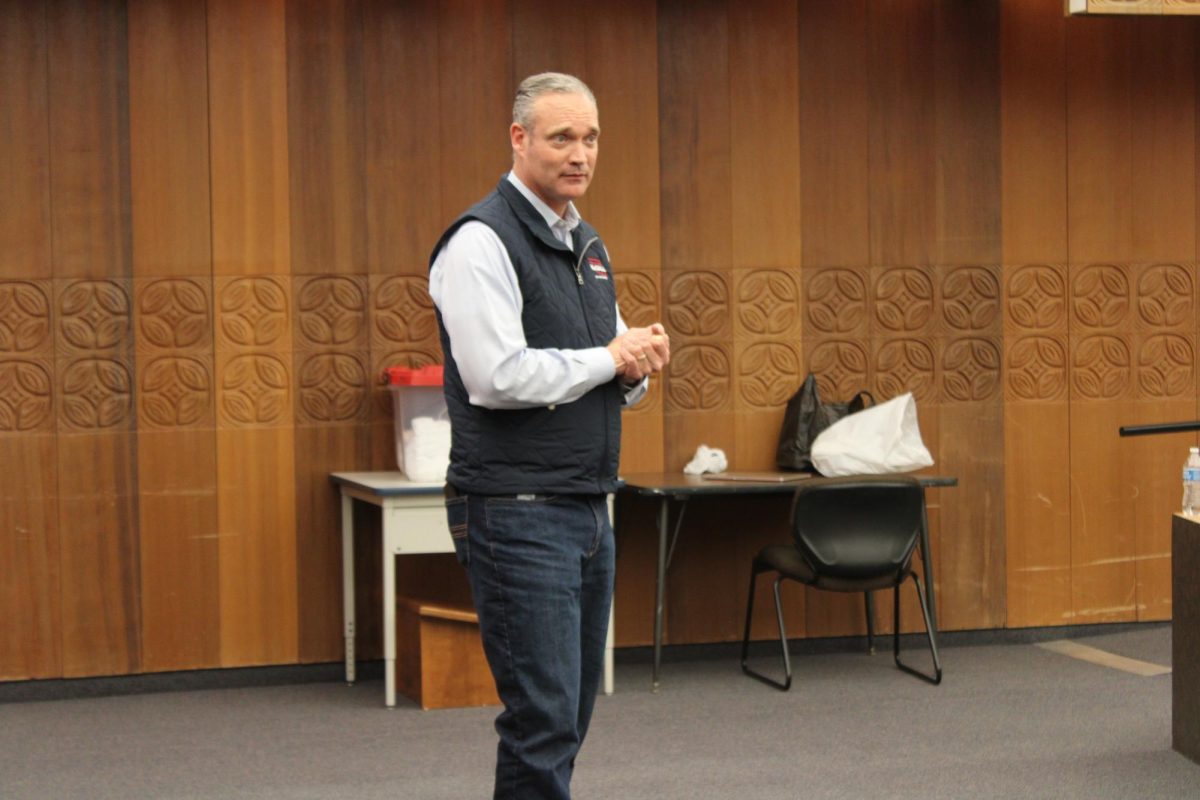











In Brazil last month, Dr. Grey Hoff went from churches to schools, meeting pastors, students and families who kept asking the same question: ‘What is ORU?’
As associate vice president for International Student Relations, Hoff traveled with international counselor Mylena Weydt to introduce Oral Roberts University to communities eager to learn more.
They spoke at major churches, shared with youth movements and hosted information sessions in São Paulo, the largest city in Brazil.
What began as a series of presentations became something more — a clear sign of ORU’s global calling and a key step in its international growth, Hoff said.
Oral Roberts University is expanding its global strategy to fulfill what founder Oral Roberts described as a mandate from God: “Raise up your students to hear My voice, to go where My light is seen dim, where My voice is heard small, and My healing power is not known, and to go even to the uttermost bounds of the Earth.”
That charge became the university’s founding vision and continues to guide its international mission today, Hoff said.
Brazil shows what happens when that vision meets spiritual hunger, he said. But ORU’s mission extends beyond one nation.
With new partnerships and international travel, the university is working to bring students from every corner of the globe.
“We have a purpose and a goal,” Hoff said, “to reach all the nations of the world and grow our international population to 50%,” more than double what it is now.
The International Student Relations office is structured for that task with counselors dedicated to Latin America, Asia, Africa, Europe and the Middle East, Hoff said.
Each builds relationships, nurtures partnerships and walks students through the admissions process step by step.
This academic year, the office has scheduled visits to Ecuador, Colombia, Singapore, Malaysia, India, Nigeria, the Philippines, El Salvador, Honduras and Canada.
On the most recent trip to Brazil, the team visited Zion Church, Paz Church, Bola de Neve Church, Dunamis Colleg, and hosted a large information session at a hotel in São Paulo.
The visit coincided with a 400% increase in website traffic and a doubling of applications compared to the same period last year, according to the International Student Relations office.
But for Hoff, the impact is about more than statistics.
“We work hard,” he said, “but we pray even harder. We’re on mission, showing up to find the students God is already speaking to.”
Nearly 27% of Brazil’s population now identifies as Evangelical, up from 21.6% in 2010. That’s nearly 50 million people, representing a growing movement, especially among young adults, according to the 2022 Brazilian census.
At ORU, students from nine new nations enrolled this fall, bringing the total number of represented countries to 174 since 2019, according to a recent university report.
International students now make up 20% of ORU’s total enrollment, with fall 2025 marking the university’s 17th consecutive year of growth.
Behind every enrollment number is a process of guidance and care.
ORU’s international counselors stay connected with students through calls, messages, and in-person visits, making sure families feel supported from application to arrival in Tulsa.
“We want them to feel seen,” Weydt said. “We’re building trust with students and families who are making a major life decision.”
The results are tangible.
Brazil contributed 46 new students this fall from all across the nation — triple the number from the year before.
“My experience at ORU so far has been amazing. I never thought a place like this existed. For me, it only exists because it was guided by God,” said João Pedro Guimarães da Motta Amadeu, a freshman from Brazil double majoring in finance and theology.
But the strategy is not only about one nation.
“The team’s ambition next year is bold: expand the Brazilian cohort to 80 students while achieving proportional growth across Asia, Africa, Latin America and other regions.”
ORU leaders believe this kind of expansion is more than enrollment management — it is obedience to a vision given decades ago.
“Our job,” Hoff said, “is to find them.”